
CIANA Pentagon in Cybersecurity: Confidentiality, Integrity, Availability, Non-Repudiation, and Authentication
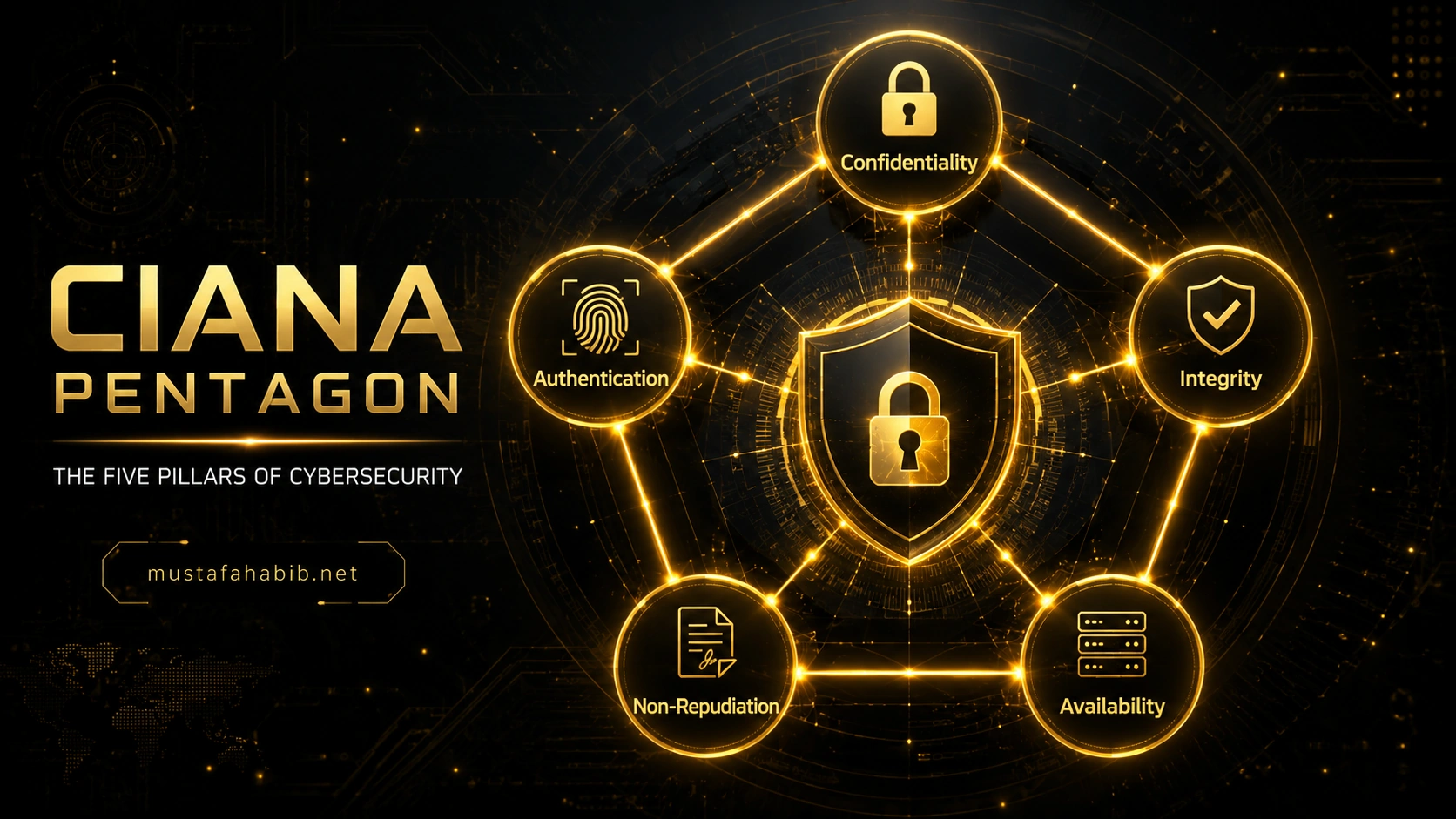
The CIANA Pentagon in cybersecurity is a practical model for understanding five essential trust requirements in digital systems: Confidentiality, Integrity, Availability, Non-Repudiation, and Authentication. It builds on the classic CIA Triad by adding two requirements that modern systems rely on every day: the ability to prove important actions and the ability to verify identity before trusting access or transactions.
Key takeaway: In this article, CIANA means Confidentiality, Integrity, Availability, Non-Repudiation, and Authentication. The model is best understood as a learning and design framework built from widely recognized security fundamentals, including the CIA Triad, non-repudiation, and authentication as part of identity and access management.
Abstract
Cybersecurity is a discipline of trust. Organizations secure networks, applications, identities, data, cloud workloads, and business processes because customers, employees, executives, regulators, partners, and public services depend on digital systems to behave correctly. A security model should therefore explain more than whether data is secret. It should also explain whether data is accurate, whether services remain usable, whether critical actions can be proven, and whether the identity behind an action is verified.
NIST describes information security as protecting information and information systems from unauthorized access, use, disclosure, disruption, modification, or destruction in order to provide confidentiality, integrity, and availability.[2] CompTIA Security+ also presents the CIA Triad, non-repudiation, and Authentication, Authorization, and Accounting (AAA) as fundamental security concepts.[1] This article uses those standard concepts to explain CIANA as a clear, practical pentagon model.
The result is a structured guide for students, security engineers, developers, auditors, penetration testers, and incident responders who want a clean way to connect technical controls with business trust requirements.
Table of Contents
- What Is the CIANA Pentagon?
- From the CIA Triad to the CIANA Pentagon
- CIANA in One Simple Model
- Confidentiality
- Integrity
- Availability
- Non-Repudiation
- Authentication
- How the Five CIANA Pillars Work Together
- CIANA and Penetration Testing
- CIANA and Security Standards
- CIANA, Zero Trust, and Secure Architecture
- CIANA and Incident Response
- CIANA and Secure-by-Design Thinking
- A Practical CIANA Checklist
- CIANA-Based Risk Statement Template
- CIANA Summary Table
- FAQ About CIANA
- Conclusion
- References and Authoritative Sources
Learning Objectives
By the end of this article, you should be able to:
- Define CIANA as Confidentiality, Integrity, Availability, Non-Repudiation, and Authentication.
- Explain how CIANA extends the CIA Triad without replacing it.
- Identify the technical and governance controls that support each CIANA pillar.
- Use CIANA to describe the business impact of penetration-testing findings.
- Apply CIANA as a checklist for secure design, security assessment, and incident response.
1. What Is the CIANA Pentagon?
The CIANA Pentagon is a five-pillar cybersecurity model:
| Letter | Pillar | Core Trust Question |
|---|---|---|
| C | Confidentiality | Who is allowed to see this information? |
| I | Integrity | Can this data, transaction, or system state be trusted? |
| A | Availability | Can authorized users access the system when they need it? |
| N | Non-Repudiation | Can a critical action or transaction be proven later? |
| A | Authentication | Has the claimed identity of the user, device, process, or workload been verified? |
The model is useful because real security failures rarely affect only one area. A single weakness can expose private data, allow unauthorized modification, disrupt operations, weaken transaction proof, and let attackers act under a false or stolen identity. CIANA helps security teams ask better questions before, during, and after a security event.
2. From the CIA Triad to the CIANA Pentagon
The CIA Triad remains one of the most important foundations in information security. NIST FIPS 199 categorizes federal information and information systems according to the potential impact of compromise to confidentiality, integrity, and availability.[3] CIANA keeps those three foundational pillars and adds two trust requirements that are especially important in modern digital systems: non-repudiation and authentication.
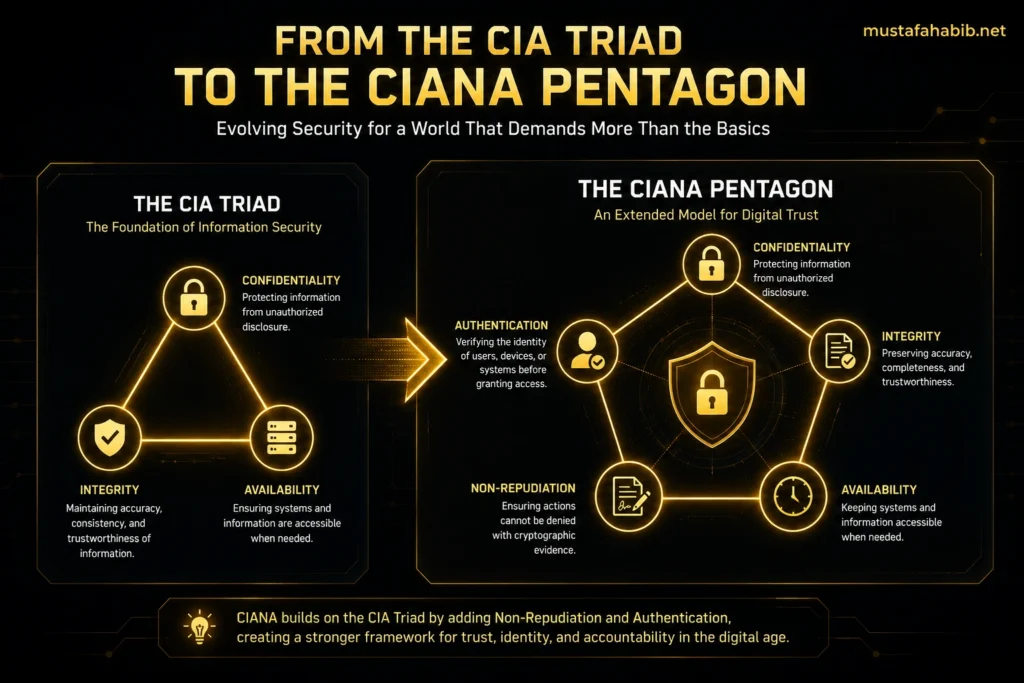
This expansion matters because many important security questions are not fully expressed by the CIA Triad alone. For example, a payment platform may keep transaction data confidential and available, but it still needs strong proof that a payment approval came from the claimed signer. A cloud management console may preserve data integrity, but it still needs strong authentication before privileged changes are allowed.
In practical terms, CIANA is a compact way to describe the full trust posture of a system:
- Confidentiality protects against unauthorized disclosure.
- Integrity protects against unauthorized or improper modification.
- Availability protects reliable access to systems and data.
- Non-Repudiation provides evidence for important actions.
- Authentication verifies identity before access or action.
3. CIANA in One Simple Model
| CIANA Pillar | Purpose | Example Controls |
|---|---|---|
| Confidentiality | Keep sensitive information away from unauthorized users, services, and systems. | Access control, encryption, data classification, least privilege, secure defaults. |
| Integrity | Preserve the accuracy, completeness, and trustworthiness of data and system state. | Input validation, authorization, hashing, digital signatures, change control. |
| Availability | Keep systems and information usable when authorized users need them. | Redundancy, backups, DDoS protection, rate limits, monitoring, incident response. |
| Non-Repudiation | Provide reliable evidence that an action, approval, message, or transaction occurred. | Digital signatures, trusted timestamps, protected logs, certificate validation. |
| Authentication | Verify the identity of a user, process, device, API client, or workload. | MFA, passkeys, certificates, tokens, device identity, service identity. |
A mature security design does not treat these pillars as isolated boxes. They reinforce one another. Strong authentication improves access decisions. Strong integrity controls make transaction records trustworthy. Strong non-repudiation makes disputes easier to resolve. Strong availability planning keeps essential services operational under stress.
4. Confidentiality: Protecting Information from Unauthorized Disclosure
4.1 Definition
Confidentiality means preserving authorized restrictions on information access and disclosure, including protection for personal privacy and proprietary information.[4] In simple terms, confidentiality asks: Who is allowed to know this?
Confidentiality applies to customer records, medical information, employee files, source code, legal documents, financial reports, credentials, API keys, vulnerability reports, cloud configuration details, and intellectual property.
4.2 Common Confidentiality Failures
- Broken access control lets one user view another user’s records.
- Cloud storage is accidentally exposed to the public internet.
- Secrets are committed to a public repository.
- APIs return more data fields than the requester needs.
- Sensitive values appear in logs, error messages, URLs, or analytics tools.
- Excessive permissions allow low-privileged users to access restricted data.
- Backups are stored without appropriate access restrictions or encryption.
4.3 Controls That Support Confidentiality
| Control Area | Examples |
|---|---|
| Access control | Role-based access control, attribute-based access control, deny-by-default design, least privilege. |
| Encryption | TLS, disk encryption, database encryption, object-storage encryption, secure key management. |
| Data minimization | Collecting, storing, processing, and returning only the data that is needed. |
| Secrets management | Vaults, scoped tokens, key rotation, removing hardcoded credentials. |
| Secure configuration | Private storage buckets, hardened defaults, disabled public access, safe error handling. |
| Monitoring | Alerts for abnormal access patterns, unusual download volume, or suspected exfiltration. |
OWASP recommends deny-by-default authorization and least privilege when designing access control.[13] That point is important because encryption alone does not guarantee confidentiality. If an application authorizes the wrong user to view a record, confidentiality fails even if the database is encrypted at rest.
4.4 Example: Healthcare Portal
Imagine a patient portal with URLs like this:
/patient/record/12345If the application checks only whether the visitor is logged in, but does not verify whether that visitor is allowed to access record 12345, a patient may be able to view someone else’s medical information by changing the record number. This is a confidentiality failure because information reaches an unauthorized person.
5. Integrity: Preserving Accuracy and Trustworthiness
5.1 Definition
Integrity means guarding against improper information modification or destruction. NIST definitions also connect integrity with authenticity and non-repudiation in several contexts.[5] In simple terms, integrity asks: Can we trust this data, transaction, configuration, or system state?
Confidentiality protects secrecy. Integrity protects correctness. A system can keep data secret and still be unsafe if attackers can silently alter the data.
5.2 Common Integrity Failures
- Changing a payment destination without authorization.
- Manipulating transaction amounts through client-side parameters.
- Altering system configuration files or cloud security groups.
- Modifying medical prescriptions, payroll records, or grades.
- Replacing legitimate software updates with malicious packages.
- Corrupting backups before launching ransomware.
- Changing CI/CD pipeline definitions to inject malicious code.
5.3 Controls That Support Integrity
| Control Area | Examples |
|---|---|
| Input validation | Server-side validation, schema validation, canonicalization, type checks. |
| Authorization | Verifying whether a user can change a specific object or execute a specific action. |
| Cryptographic integrity | Hashes, HMACs, checksums, digital signatures. |
| Change management | Peer review, approval workflows, separation of duties, deployment controls. |
| Software supply-chain security | Signed releases, dependency review, protected build pipelines, artifact verification. |
| Backup integrity | Immutable backups, restore testing, malware scanning, integrity verification. |
5.4 Example: Online Checkout
A checkout request may look like this:
{
  "product_id": "P-1009",
  "quantity": 1,
  "price": 10
}
If the server trusts the client-provided price, an attacker may change 10 to 1. The transaction may remain private, but the business process loses integrity. A secure design calculates the price on the server from trusted product data.
6. Availability: Keeping Systems Accessible When Needed
6.1 Definition
Availability means ensuring timely and reliable access to and use of information.[6] In practical cybersecurity terms, availability asks: Can authorized users access the system, service, or data when they need it?
Availability is not only an IT operations concern. It is a security objective because attackers can directly target uptime, business continuity, and recovery capability through ransomware, denial-of-service attacks, destructive malware, account lockout abuse, and resource exhaustion.
6.2 Common Availability Failures
- Ransomware encrypts production systems.
- A distributed denial-of-service attack overwhelms public services.
- A critical authentication provider becomes unavailable.
- Expired TLS certificates prevent users from connecting.
- A database runs out of disk space.
- A missing rate limit allows resource exhaustion.
- Backups exist but cannot be restored within the required recovery time.
- A single point of failure takes down a critical workflow.
The CISA StopRansomware Guide provides prevention and response practices to help organizations reduce ransomware risk and prepare for ransomware incidents.[21] This matters because ransomware often creates an availability crisis, not only a confidentiality or integrity problem.
6.3 Controls That Support Availability
| Control Area | Examples |
|---|---|
| Resilience architecture | Redundancy, clustering, failover, load balancing, graceful degradation. |
| Backup and recovery | Offline backups, immutable backups, tested restoration, recovery time objectives. |
| DDoS protection | Traffic filtering, upstream protection, rate limiting, edge protection. |
| Capacity management | Load testing, resource quotas, autoscaling, dependency monitoring. |
| Patch management | Reducing exposure to known exploited vulnerabilities and destructive malware. |
| Incident response | Playbooks, escalation paths, communication plans, exercises, recovery drills. |
6.4 Example: Authentication Provider Outage
A SaaS application may have healthy servers and databases, but if its identity provider is unavailable, users may be unable to log in. From a CIANA perspective, this becomes an availability issue. Strong architecture should include resilience planning for critical identity dependencies, backup access procedures, and carefully controlled emergency access paths.
7. Non-Repudiation: Making Critical Actions Provable
7.1 Definition
Non-repudiation provides assurance that the origin and integrity of data can be verified and validated so that an entity cannot easily deny a specific action, message, or transaction later.[7] In simple terms, non-repudiation asks: Can this important action be proven?
Non-repudiation is essential in systems involving electronic signatures, high-value payments, legal submissions, medical prescriptions, software releases, certificate issuance, administrative changes, and regulatory filings.
7.2 Digital Signatures and Proof
Digital signatures are one of the most important mechanisms for non-repudiation. NIST describes a properly implemented digital signature as providing origin authentication, data integrity, and signer non-repudiation.[8] This is why signing is so important for software releases, document approvals, and high-value transactions.
Digital signatures do not remove the need for secure operations. They depend on protected private keys, sound certificate validation, trusted timestamps, secure signing workflows, and reliable evidence preservation.
7.3 Controls That Support Non-Repudiation
| Control Area | Examples |
|---|---|
| Digital signatures | Signing transactions, documents, releases, approvals, and messages. |
| Public key infrastructure | Certificates, certificate authorities, revocation checking, trust chains. |
| Timestamping | Trusted time sources, signed timestamps, synchronized clocks. |
| Key protection | Hardware security modules, key rotation, access policies, restricted signing permissions. |
| Evidence preservation | Protected audit records, immutable storage, chain-of-custody processes. |
| Approval workflows | Dual control, separation of duties, verified approval steps. |
7.4 Example: Software Release Signing
A software vendor publishes an update. Customers need to know that the update genuinely came from the vendor and was not modified by an attacker. Code signing helps customers verify origin and integrity, and it provides evidence that a signing key approved the release. The strength of that evidence depends on how well the signing key, build pipeline, and release process are protected.
8. Authentication: Verifying Identity Before Trust
8.1 Definition
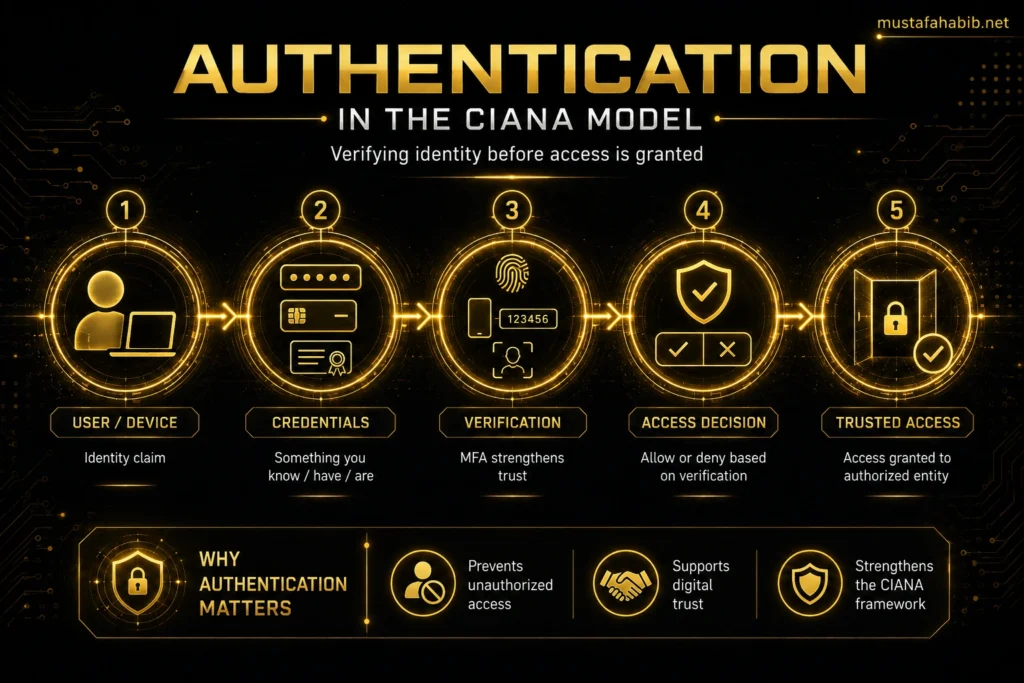
Authentication is the process of verifying the identity of a user, process, or device, often before allowing access to resources in an information system.[9] In CIANA, authentication asks: Is this actor really who or what it claims to be?
Authentication applies not only to human users. It also applies to administrators, service accounts, APIs, workloads, devices, certificates, automation jobs, and machine-to-machine communication.
8.2 Authentication Is Not Authorization
Authentication verifies identity. Authorization decides what the verified identity is allowed to do. A user may be correctly authenticated and still be unauthorized to view a particular customer record, approve a payment, or change a firewall rule.
This distinction is critical. A login screen proves only that an identity has been verified. Every sensitive action still needs proper authorization checks.
8.3 Authentication Factors and Authenticators
NIST describes authentication factors such as something you know, something you have, and something you are.[9] Modern authentication systems can use several kinds of authenticators:
- Knowledge factors: passwords, PINs, recovery codes.
- Possession factors: hardware security keys, authenticator apps, smart cards, passkeys, certificates.
- Inherence factors: biometrics such as fingerprint or face recognition, when implemented safely and appropriately.
- Device and workload identity: certificates, signed tokens, managed device posture, workload attestation.
NIST SP 800-63B focuses on authentication and authenticator management for subjects interacting with government information systems over networks and defines technical requirements for authenticator assurance levels.[10] OWASP also provides practical guidance for authentication design, password handling, and multi-factor authentication.[11][12]
8.4 Common Authentication Failures
- No MFA on administrative accounts.
- Weak password policy or no breached-password screening.
- Credential stuffing protections are missing.
- Session tokens are predictable, exposed, or not invalidated properly.
- Privilege-sensitive actions do not require reauthentication.
- API keys are long-lived, over-scoped, or stored in source code.
- Service accounts share credentials across systems.
- MFA can be bypassed through alternate login flows.
- Password reset workflows allow account takeover.
- Device or workload identity is trusted without validation.
OWASP API Security lists Broken Authentication as a major API security risk because weaknesses in authentication mechanisms can let attackers assume other users’ identities or abuse credentials and tokens.[15]
8.5 Controls That Support Authentication
| Control Area | Examples |
|---|---|
| Multi-factor authentication | Phishing-resistant MFA where appropriate, authenticator apps, hardware security keys, passkeys. |
| Password security | Strong password storage, breached-password checks, safe reset flows, protection against credential stuffing. |
| Session management | Secure cookies, token rotation, timeout policies, invalidation on risk events. |
| API authentication | Scoped tokens, short-lived credentials, certificate-based authentication, signed requests. |
| Device and workload identity | Managed device checks, certificates, workload identity federation, machine identity lifecycle. |
| Adaptive controls | Step-up authentication for risky actions, context-aware access, impossible-travel detection. |
8.6 Example: Admin Panel Access
Consider a cloud admin panel that controls production databases. A password-only login creates high risk because one stolen password may allow destructive changes. A stronger CIANA design would require phishing-resistant MFA for administrators, device posture checks, short session lifetimes, step-up authentication for destructive actions, and detailed event records for sensitive changes.
9. How the Five CIANA Pillars Work Together
CIANA is most valuable when the five pillars are evaluated together. Consider an online banking platform:
| CIANA Pillar | Banking Example |
|---|---|
| Confidentiality | Account details are visible only to authorized customers and staff. |
| Integrity | Balances and payment instructions cannot be changed without authorization. |
| Availability | Customers can access funds and banking services when needed. |
| Non-Repudiation | High-value transfers have strong evidence of approval. |
| Authentication | Customers, staff, APIs, and administrative sessions are tied to verified identities. |
A single defect can affect several pillars. For example, broken object-level authorization in an API may expose another customer’s invoice, which affects confidentiality. If the same endpoint allows unauthorized edits, integrity is affected. If high-value changes are not strongly evidenced, non-repudiation is affected. If stolen credentials are enough to make changes without MFA or reauthentication, authentication is part of the failure chain.
10. CIANA and Penetration Testing
Penetration testing should not only identify vulnerabilities. It should explain security impact. NIST SP 800-115 provides guidance for planning and conducting technical security tests and assessments, analyzing findings, and developing mitigation strategies.[16] CIANA helps testers translate technical findings into business risk language.
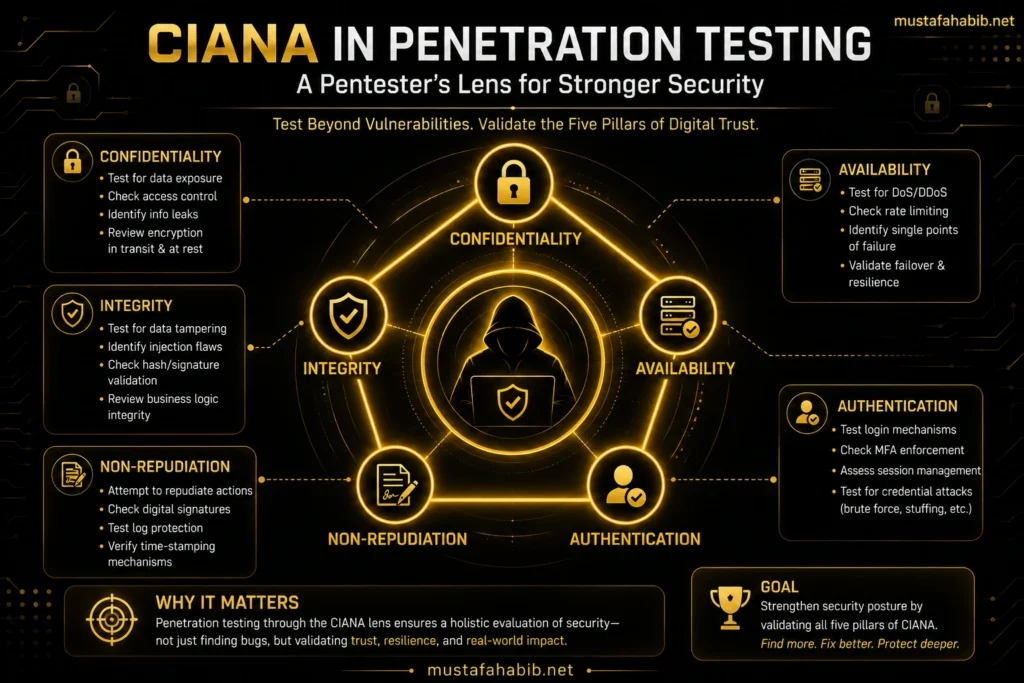
Instead of writing only:
“Broken access control was found.”
A stronger report can write:
“The broken access control vulnerability allows one authenticated user to view another user’s invoices. This affects confidentiality because invoice data is exposed to an unauthorized user. The same endpoint also allows invoice metadata changes, which affects integrity. Because the application does not require step-up authentication for sensitive changes, the issue also weakens the authentication posture for high-risk actions.”
10.1 Testing Confidentiality
- Can one user view another user’s data?
- Do APIs expose fields that the requester does not need?
- Are secrets stored in repositories, logs, client-side code, or cloud metadata?
- Are storage buckets, backups, or debug endpoints exposed?
- Can low-privileged roles access administrative information?
OWASP API Security identifies broken object-level authorization as a major API risk because APIs often expose endpoints that handle object identifiers, creating a wide attack surface for object-level access control issues.[14]
10.2 Testing Integrity
- Can users modify objects they do not own?
- Can client-side parameters change trusted server-side decisions?
- Can SQL injection or command injection alter data or system state?
- Can CI/CD pipelines, dependencies, or update packages be tampered with?
- Are important records protected against unauthorized changes?
10.3 Testing Availability
- Are rate limits missing on expensive endpoints?
- Can large payloads cause excessive CPU, memory, or database load?
- Can account lockout logic be abused to deny service to users?
- Are critical dependencies single points of failure?
- Are backup and restoration procedures tested?
Ethical testing note: Availability testing can disrupt production systems. Denial-of-service testing must be explicitly authorized, carefully scoped, coordinated, and monitored.
10.4 Testing Non-Repudiation
- Are high-value transactions tied to strong evidence?
- Are digital signatures, timestamps, and transaction records implemented correctly?
- Are private signing keys protected?
- Can evidence be modified after the action?
- Can a user plausibly deny a critical action because the proof is weak?
10.5 Testing Authentication
- Can credential stuffing or brute-force attacks bypass rate limits?
- Can MFA be bypassed through backup flows, legacy protocols, or direct API calls?
- Are session tokens protected, rotated, and invalidated correctly?
- Does password reset allow account takeover?
- Are admin functions protected by step-up authentication?
- Are API keys scoped, rotated, and stored securely?
- Can service accounts or workload identities be reused outside their intended context?
11. CIANA and Security Standards
CIANA is not a replacement for formal standards or control catalogs. It is a practical model that helps organize security objectives. The concepts behind it align with widely used references such as CompTIA Security+, NIST terminology, NIST FIPS publications, and NIST SP 800-53 security control families.[1][17]
| CIANA Pillar | Relevant Standards Concepts | Typical Control Themes |
|---|---|---|
| Confidentiality | CIA Triad, access control, privacy and data protection. | Least privilege, encryption, data minimization, secure configuration. |
| Integrity | CIA Triad, system and information integrity, change management. | Validation, approved changes, tamper detection, signed artifacts. |
| Availability | CIA Triad, contingency planning, incident response, resilience. | Backups, redundancy, DDoS protection, monitoring, recovery testing. |
| Non-Repudiation | Digital signatures, PKI, transaction evidence, audit records. | Signing, timestamping, certificate validation, evidence protection. |
| Authentication | AAA, identity and access management, authenticator assurance. | MFA, passkeys, device identity, token security, session controls. |
12. CIANA, Zero Trust, and Secure Architecture
NIST SP 800-207 describes zero trust as a shift away from static, network-based perimeters toward users, assets, and resources.[18] CIANA fits naturally with this mindset because it asks security teams to define the trust outcomes they expect from every sensitive resource.
| Zero Trust Concern | CIANA Connection |
|---|---|
| Verify identity and context | Supports authentication, confidentiality, and non-repudiation. |
| Enforce least privilege | Supports confidentiality and integrity. |
| Protect resources directly | Supports all five CIANA pillars. |
| Monitor activity continuously | Supports integrity, availability, non-repudiation, and authentication assurance. |
| Assume breach | Supports resilience, investigation, recovery, and identity verification under stress. |
CIANA defines the security outcomes. Zero trust helps implement those outcomes in modern cloud, hybrid, API-driven, and identity-centric environments.
13. CIANA and Incident Response
During incident response, CIANA provides a fast way to ask what failed and what evidence exists. NIST SP 800-61 Rev. 3 connects incident response with cybersecurity risk management and the NIST Cybersecurity Framework 2.0 functions: Govern, Identify, Protect, Detect, Respond, and Recover.[19][20]
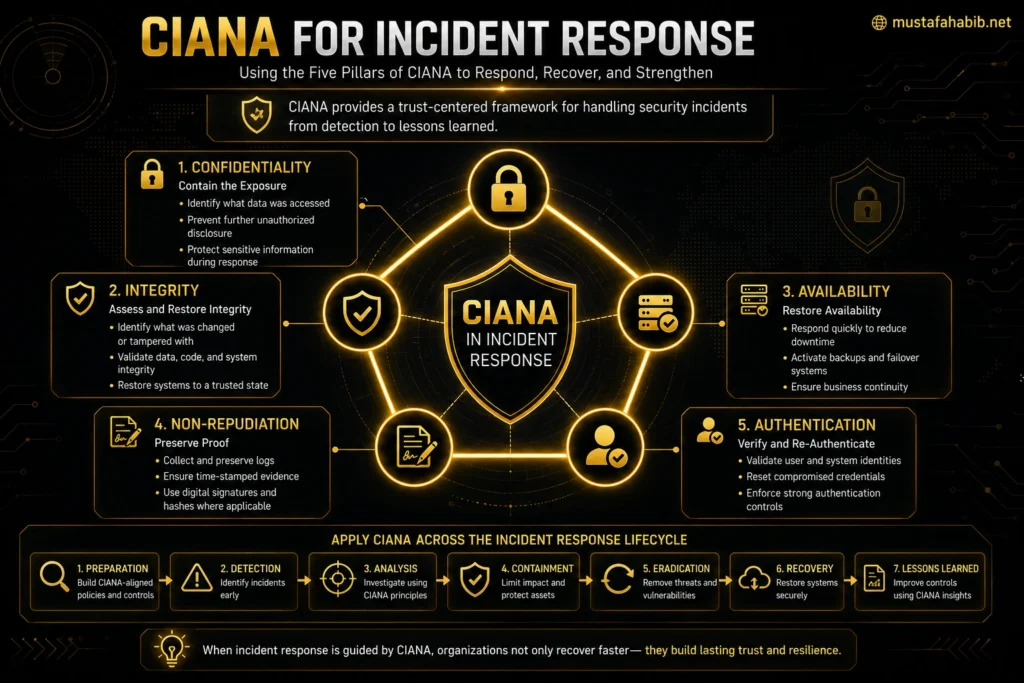
| Incident Question | CIANA Pillar |
|---|---|
| Was sensitive data accessed, copied, or disclosed? | Confidentiality |
| Was data modified, deleted, corrupted, or tampered with? | Integrity |
| Are systems, accounts, and services operational? | Availability |
| Can we prove who approved or initiated the critical action? | Non-Repudiation |
| Was the actor’s identity verified, or were credentials/tokens abused? | Authentication |
If authentication evidence is weak, responders may not know whether an action came from a legitimate user, a stolen credential, a compromised token, or an automated workload. If integrity controls are weak, responders may not know which records can still be trusted. If availability planning is weak, recovery may take longer than the business can tolerate.
14. CIANA and Secure-by-Design Thinking
CISA’s secure-by-design guidance encourages technology manufacturers to build products that are secure by design and secure by default.[22] CIANA supports that mindset by turning security design into five concrete questions:
| Design Question | CIANA Pillar |
|---|---|
| What data should never be exposed to unauthorized users or systems? | Confidentiality |
| What data, configuration, or workflow must never be silently altered? | Integrity |
| What services must remain usable during stress, outage, or attack? | Availability |
| What actions require evidence strong enough for disputes, audits, or legal review? | Non-Repudiation |
| Which users, devices, services, and workloads must prove their identity? | Authentication |
These questions should influence product architecture, default settings, authentication flows, administrative workflows, API design, logging, key management, and recovery planning from the beginning of the development lifecycle.
15. A Practical CIANA Checklist
Confidentiality Checklist
- Have sensitive data types been identified and classified?
- Is least privilege enforced for users, services, APIs, and administrators?
- Are access decisions enforced server-side on every sensitive object?
- Is sensitive data encrypted in transit and at rest where appropriate?
- Are secrets removed from source code, logs, tickets, and client-side bundles?
- Do APIs return only the fields the requester is authorized to receive?
Integrity Checklist
- Is server-side validation enforced for all critical inputs?
- Can users modify only objects and fields they are authorized to modify?
- Are important records protected from unauthorized edits and deletion?
- Are software releases, updates, and deployment artifacts signed or verified?
- Are backups protected from unauthorized modification?
- Is configuration drift detected and reviewed?
Availability Checklist
- Are recovery time objectives and recovery point objectives defined?
- Are backups tested through actual restoration exercises?
- Are critical services redundant or able to degrade gracefully?
- Are rate limits and resource quotas enforced?
- Are identity dependencies included in availability planning?
- Are incident response and disaster recovery procedures exercised?
Non-Repudiation Checklist
- Are high-value transactions linked to strong proof?
- Are digital signatures used where business, legal, or technical evidence requires them?
- Are signing keys protected from theft and misuse?
- Are timestamps reliable and consistent?
- Are approval records tamper-evident?
- Can evidence be verified by an appropriate third party when required?
Authentication Checklist
- Is MFA required for privileged and high-risk accounts?
- Are phishing-resistant authentication methods used where appropriate?
- Are password reset and account recovery flows protected against takeover?
- Are sessions rotated, expired, and invalidated correctly?
- Are API tokens and keys scoped, rotated, and stored securely?
- Are device, service, and workload identities verified before trust-sensitive access?
16. CIANA-Based Risk Statement Template
Security teams and penetration testers can use CIANA to write clearer risk statements:
Because [vulnerability or weakness] exists, [threat actor or unauthorized user] can [action].
This affects [CIANA pillar or pillars] because [security consequence].
The likely business impact is [privacy, financial, legal, operational, safety, or reputational impact].
Recommended remediation is [control or design change].
Example:
Because the invoice API does not verify object ownership, an authenticated user can view and modify invoices belonging to other customers. This affects confidentiality because invoice details are exposed to unauthorized users, and integrity because invoice metadata can be changed without permission. The likely business impact includes privacy exposure, billing disputes, and loss of trust in financial records. Recommended remediation is to enforce object-level authorization on every invoice read and update operation, add regression tests for authorization boundaries, and require step-up authentication for sensitive invoice changes.17. CIANA Summary Table
| Pillar | Protects Against | Example Failure | Example Controls |
|---|---|---|---|
| Confidentiality | Unauthorized disclosure | User views another customer’s private data. | Access control, encryption, least privilege, data minimization. |
| Integrity | Unauthorized or improper modification | Payment destination is changed by tampering with a request. | Validation, authorization, hashing, signatures, change control. |
| Availability | Loss of reliable access | Ransomware or resource exhaustion makes a service unavailable. | Backups, redundancy, rate limits, monitoring, incident response. |
| Non-Repudiation | Denial of critical actions | A user denies approving a high-value transfer. | Digital signatures, timestamps, protected evidence, key management. |
| Authentication | False or unverified identity | An attacker logs in with stolen credentials and no MFA challenge. | MFA, passkeys, certificates, session controls, token protection. |
18. FAQ About CIANA
What does CIANA stand for in cybersecurity?
CIANA stands for Confidentiality, Integrity, Availability, Non-Repudiation, and Authentication. It is a practical model for understanding security as a combination of secrecy, correctness, uptime, proof, and verified identity.
How is CIANA different from the CIA Triad?
The CIA Triad focuses on confidentiality, integrity, and availability. CIANA keeps those three pillars and adds non-repudiation and authentication, which are important for proving critical actions and verifying the identities behind access and transactions.
Why is authentication part of CIANA?
Authentication is part of CIANA because modern systems need to verify the identity of users, devices, processes, services, and workloads before granting trust-sensitive access or accepting important actions.
Why is non-repudiation important?
Non-repudiation is important because many systems need evidence that a specific action occurred. Examples include digital contract signing, payment approvals, software release signing, administrative changes, and regulated submissions.
Is authentication the same as authorization?
No. Authentication verifies identity. Authorization decides what that verified identity is allowed to do. Both are necessary, but they answer different security questions.
How does CIANA help penetration testers?
CIANA helps penetration testers explain impact more clearly. A tester can map each finding to confidentiality, integrity, availability, non-repudiation, authentication, or multiple pillars at the same time.
19. Conclusion: CIANA Is a Model for Digital Trust
The CIANA Pentagon is a practical way to think about cybersecurity outcomes. It begins with the CIA Triad and adds two modern trust requirements: non-repudiation and authentication.
A trustworthy system should:
- Keep sensitive information confidential.
- Preserve the accuracy and reliability of data.
- Remain available for authorized use.
- Provide reliable evidence for critical actions and transactions.
- Verify identities before granting trust-sensitive access.
Cybersecurity tools will continue to evolve. Attack techniques will change. Cloud, AI, automation, identity systems, and API ecosystems will become more complex. But the core requirements of trust remain durable.
Confidentiality, Integrity, Availability, Non-Repudiation, and Authentication are not just academic concepts. They are practical requirements for protecting trust in the digital world.
References and Authoritative Sources
- CompTIA, “Security+ Certification,” section “General security concepts,” listing CIA, non-repudiation, and AAA as fundamental concepts. https://www.comptia.org/en-us/certifications/security/ ↩
- NIST Computer Security Resource Center, “Information Security,” NIST Glossary. https://csrc.nist.gov/glossary/term/information_security ↩
- National Institute of Standards and Technology, FIPS 199, Standards for Security Categorization of Federal Information and Information Systems. https://csrc.nist.gov/pubs/fips/199/final ↩
- NIST Computer Security Resource Center, “Confidentiality,” NIST Glossary. https://csrc.nist.gov/glossary/term/confidentiality ↩
- NIST Computer Security Resource Center, “Integrity,” NIST Glossary. https://csrc.nist.gov/glossary/term/integrity ↩
- NIST Computer Security Resource Center, “Availability,” NIST Glossary. https://csrc.nist.gov/glossary/term/availability ↩
- NIST Computer Security Resource Center, “Non-Repudiation,” NIST Glossary. https://csrc.nist.gov/glossary/term/non_repudiation ↩
- NIST Computer Security Resource Center, “Digital Signature,” NIST Glossary. https://csrc.nist.gov/glossary/term/digital_signature ↩
- NIST Computer Security Resource Center, “Authentication,” NIST Glossary. https://csrc.nist.gov/glossary/term/authentication ↩
- National Institute of Standards and Technology, SP 800-63B-4, Digital Identity Guidelines: Authentication and Authenticator Management. https://csrc.nist.gov/pubs/sp/800/63/b/4/final ↩
- OWASP Cheat Sheet Series, “Authentication Cheat Sheet.” https://cheatsheetseries.owasp.org/cheatsheets/Authentication_Cheat_Sheet.html ↩
- OWASP Cheat Sheet Series, “Multifactor Authentication Cheat Sheet.” https://cheatsheetseries.owasp.org/cheatsheets/Multifactor_Authentication_Cheat_Sheet.html ↩
- OWASP Cheat Sheet Series, “Authorization Cheat Sheet.” https://cheatsheetseries.owasp.org/cheatsheets/Authorization_Cheat_Sheet.html ↩
- OWASP API Security Top 10 2023, “API1:2023 Broken Object Level Authorization.” https://owasp.org/API-Security/editions/2023/en/0xa1-broken-object-level-authorization/ ↩
- OWASP API Security Top 10 2023, “API2:2023 Broken Authentication.” https://owasp.org/API-Security/editions/2023/en/0xa2-broken-authentication/ ↩
- National Institute of Standards and Technology, SP 800-115, Technical Guide to Information Security Testing and Assessment. https://csrc.nist.gov/pubs/sp/800/115/final ↩
- National Institute of Standards and Technology, SP 800-53 Rev. 5, Security and Privacy Controls for Information Systems and Organizations. https://csrc.nist.gov/pubs/sp/800/53/r5/upd1/final ↩
- National Institute of Standards and Technology, SP 800-207, Zero Trust Architecture. https://csrc.nist.gov/pubs/sp/800/207/final ↩
- National Institute of Standards and Technology, SP 800-61 Rev. 3, Incident Response Recommendations and Considerations for Cybersecurity Risk Management. https://csrc.nist.gov/pubs/sp/800/61/r3/final ↩
- National Institute of Standards and Technology, The NIST Cybersecurity Framework 2.0. https://www.nist.gov/cyberframework ↩
- Cybersecurity and Infrastructure Security Agency, “StopRansomware Guide.” https://www.cisa.gov/resources-tools/resources/stopransomware-guide ↩
- Cybersecurity and Infrastructure Security Agency, “Secure-by-Design.” https://www.cisa.gov/resources-tools/resources/secure-by-design ↩